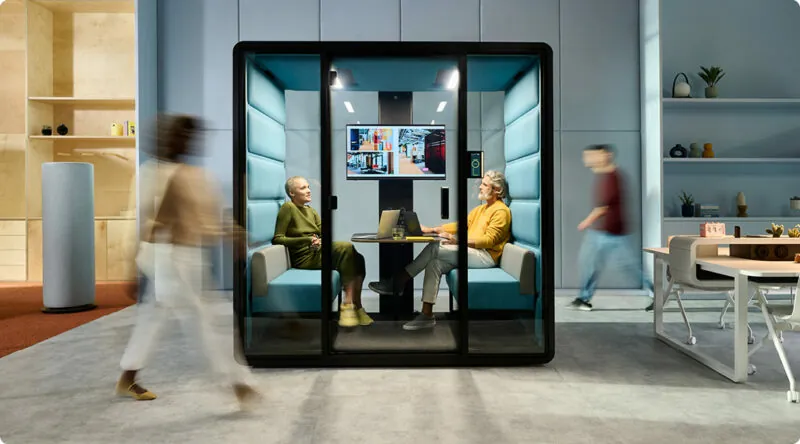
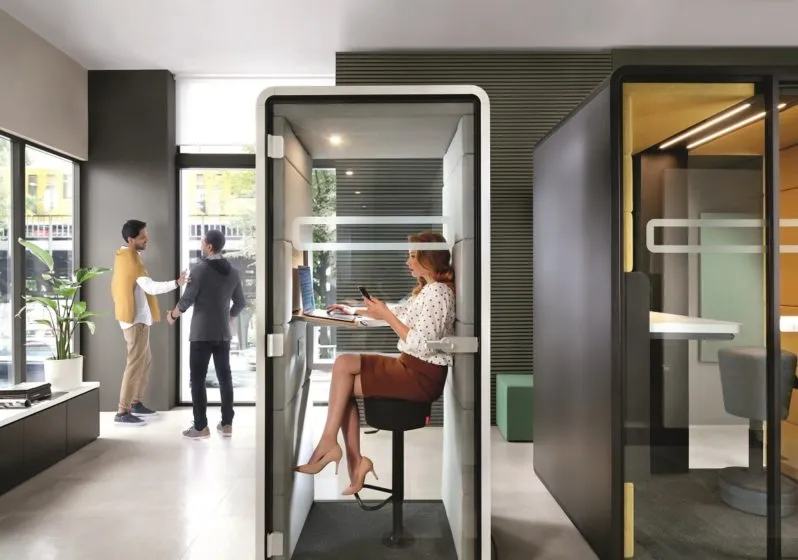
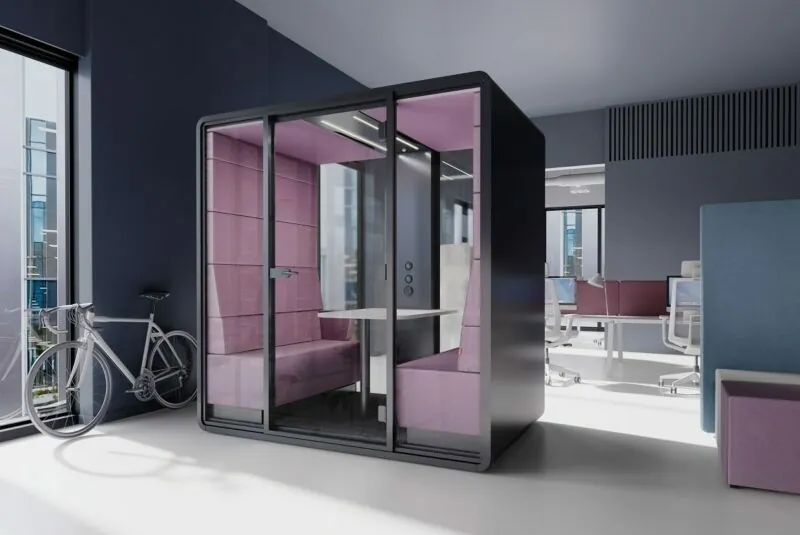
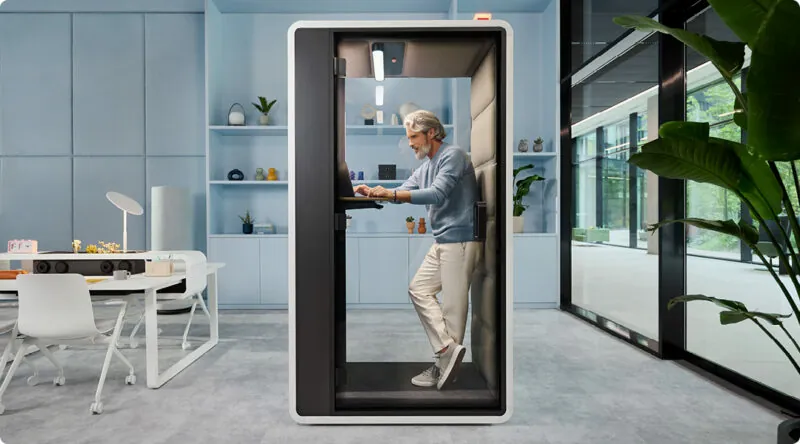
People are spending more days on site, AI is taking over repetitive tasks, and employees want spaces that help them feel comfortable. Movable pods and small private spaces like hushFree pods give everyone the control they need to do their best work in this year’s office environment.
tl;dr
Hybrid stabilizes, making flexibility mandatory
Well-being becomes a core business concern
Offices will be organized as ecosystems with distinct, interoperable zones
AI increases the premium on human-focused spaces
Sustainability and mobility as inseparable imperatives
Trend #1: Hybrid stabilizes, making flexibility mandatory.
Over the course of the year, many organizations have moved from ad-hoc hybrid plans to fixed hybrid rhythms. Indeed, hybrid employees now spend more of their week in the office than they did immediately post-pandemic.
Reservable spaces matter in a hybrid, hot-desking world.
Claimable spaces like pods give employees a predictable, private place to do focused work without having to take up a permanent desk. They provide consistency in an environment where seating and availability otherwise change day to day.
Pods and booths “normalize” unpredictability in hybrid schedules.
One of the quiet frictions of hybrid work is uncertainty. Not just about who will be in the office, but how the space will feel on any given day. Some days are quiet; others are unexpectedly chaotic. People don’t just need privacy but a buffer against the volatility of hybrid presence.
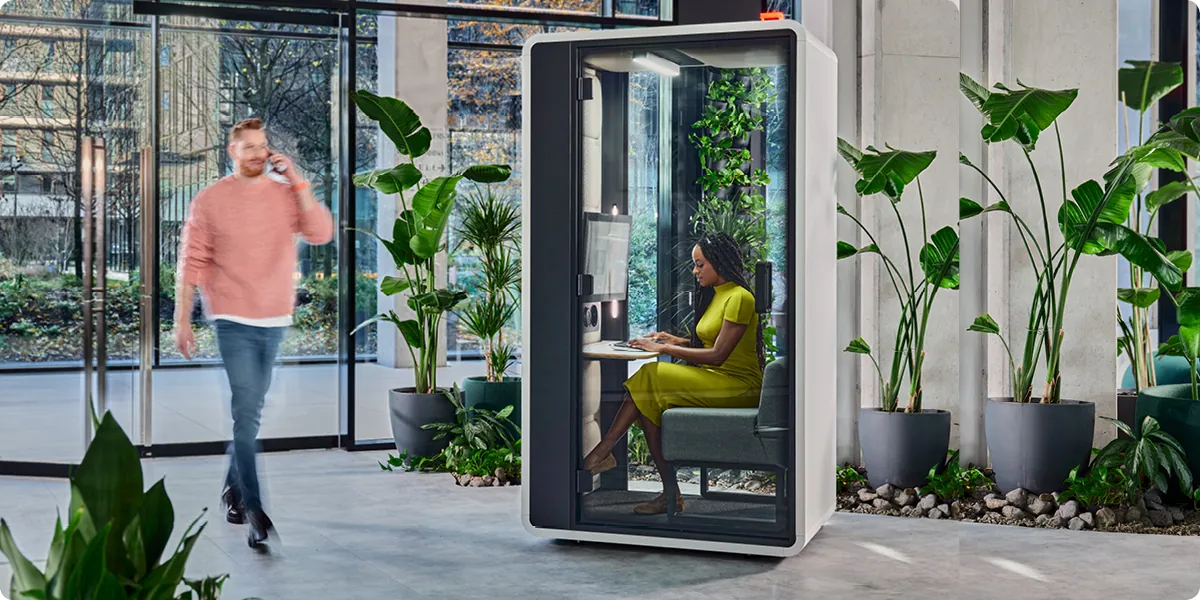
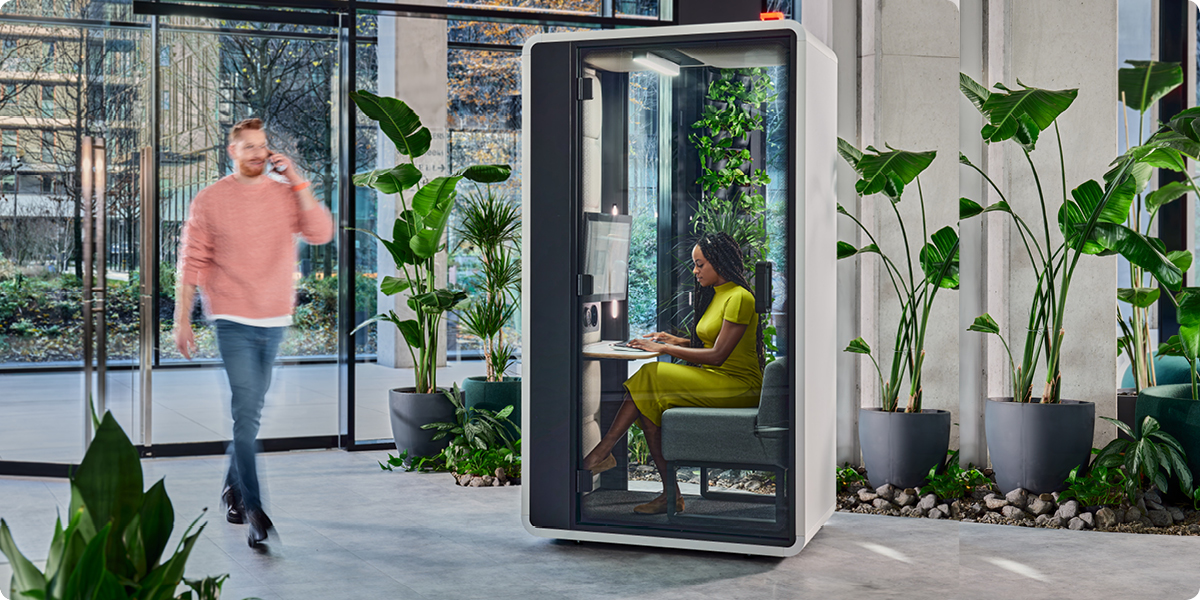
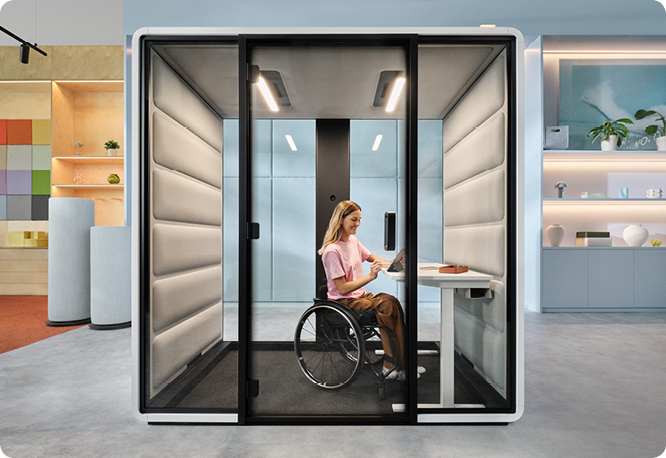
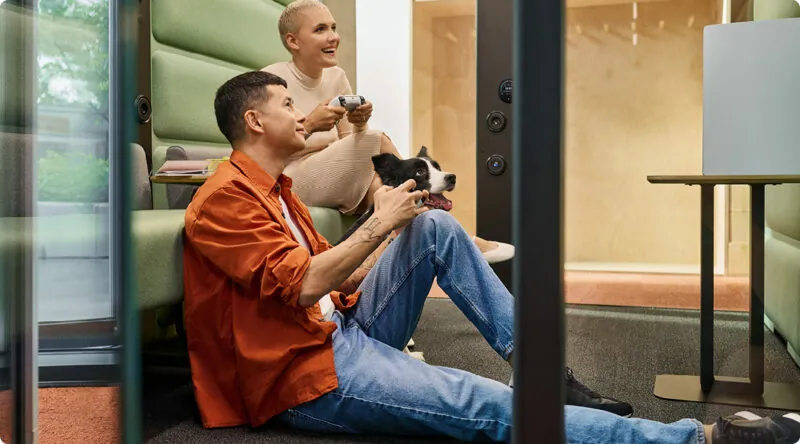
For neurodivergent employees, work pods like hushFree.S.Hybrid are where focus feels safe.
Even if the office is unusually full, noisy, or overstimulating, a pod guarantees the same acoustics, the same lighting, the same sense of enclosure, the same cognitive relief.
“Consistency is incredibly valuable to people who thrive on stable sensory conditions — especially neurodivergent employees. And it makes hybrid attendance less of a gamble. What this really offers is predictability, one of the most powerful forms of psychological safety for neurodivergent individuals. When the outside environment fluctuates wildly — new sounds, sudden movement, shifting social energy — the brain has to work harder to regulate itself. A pod acts as a sensory grounding point. It is a place where nothing unexpected happens. Inside, the brain doesn’t have to keep scanning for change. That reduction in “background vigilance” frees up mental bandwidth for thinking, for creating, for participating,” Marcin Ścigała, Senior Marketing Specialist at Hushoffice.
HushFree.S.hybrid acts like a small anchor within spatial volatility. It provides stable sensory conditions that don’t change from day to day.
Trend #2: In 2026, well-being is a primary business concern.
Well-being is a strategic priority for employers in 2026. Many will be carving out more dedicated zones for quiet and restoration in the office. With organizations realizing that sensory comfort is key to mental health, lighting, acoustics , and ergonomics will be fine-tuned toward harmony,
In-office recovery spaces like hushFree booths matter more than ever.
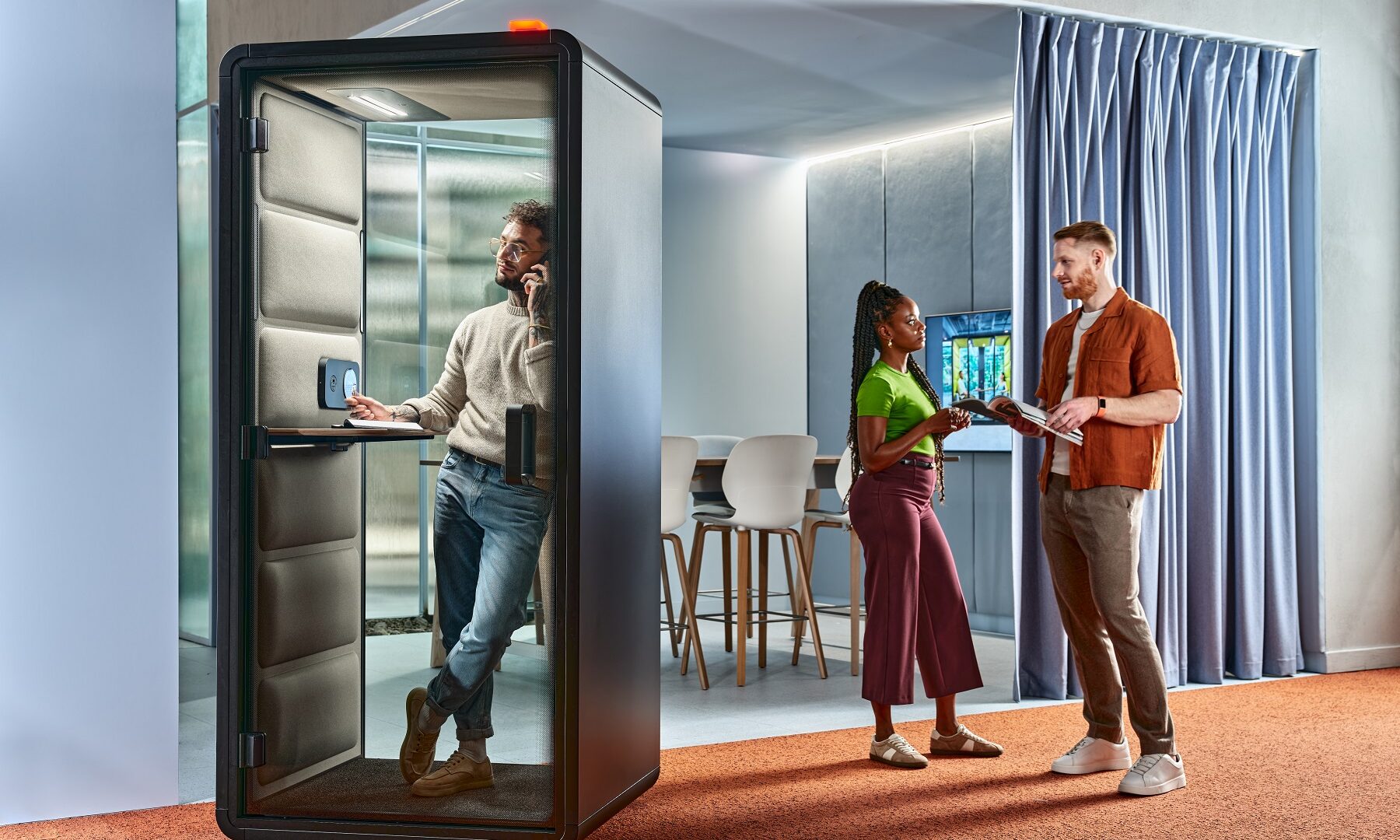
Pods are secure and low-stimulation. They give employees a chance to relax their nervous systems throughout the middle of the day. And short, protected resets help interrupt the very stress cycles that Aflac’s report points to.
Controlled acoustics. Reduced visual stimuli. Spatial stability. These conditions downshift the brain from alertness into a more regulated state. Yes, physiological refreshes are inflection points where the body regains its sense of safety and control, for a pleasanter, steadier focus.
“Humans move through the world as sensory organisms first and knowledge workers second. So long before the rational brain weighs in, the nervous system is constantly scanning light, sound, temperature, and motion to decide whether we’re safe or under strain. When those signals are chaotic — too bright, too loud, too unpredictable — the body goes into a subtle defensive mode. This drains attention and shortens patience. In that sense, our performance at work is inseparable from the sensory landscape around us. And pods work, in turn, because they give this ancient biology a break. They dial down the inputs. They hush the background threats. They create conditions where the mind can think without the body bracing against its environment,” Marcin Ścigała.
Trend #3: Offices will be organized as ecosystems with distinct, interoperable zones.
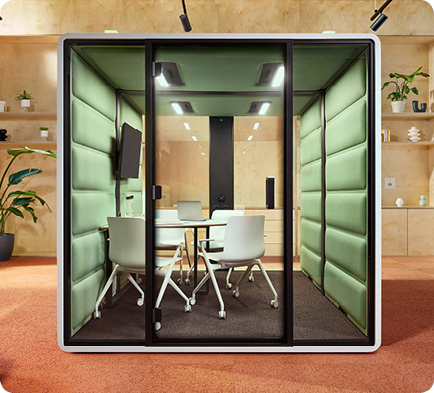
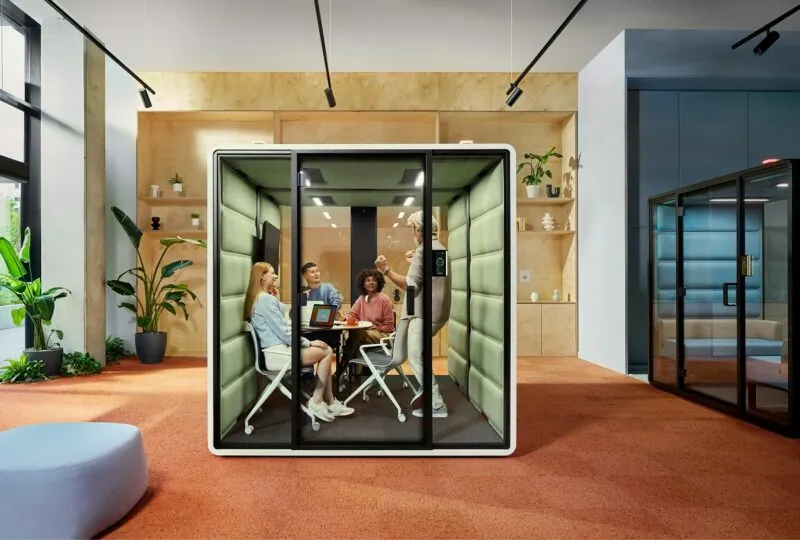
Pods and booths become plug-and-play elements in this toolkit.
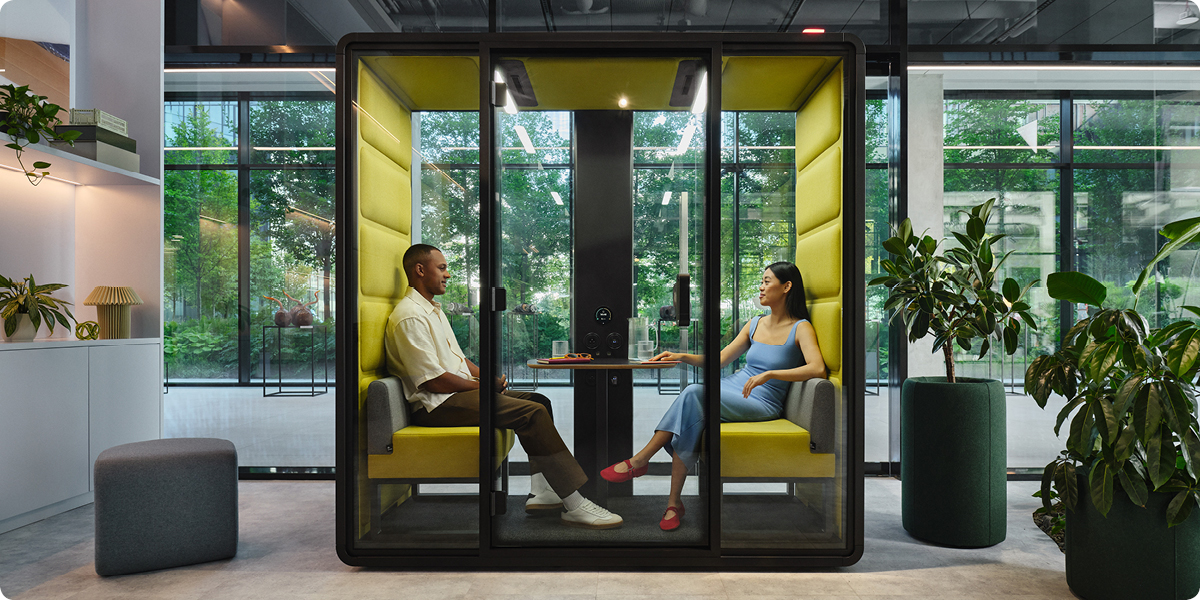
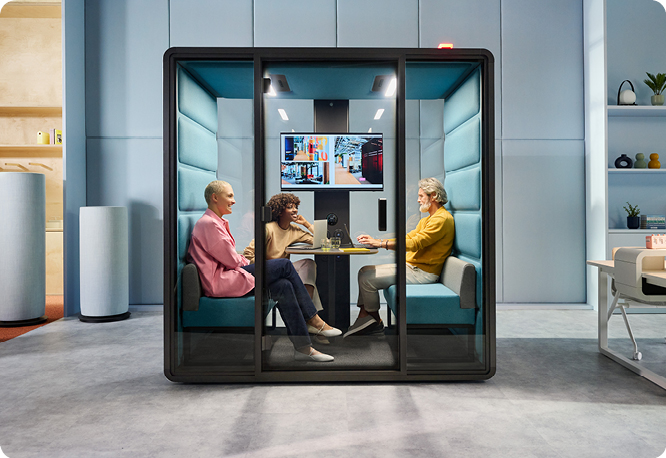
Booths are the nodes that let people change scale quickly: from social to solo, from high energy to low stimulus. They make every transition easier and less costly.
Trend reports increasingly call out micro-zoning and mobile furniture as top design responses for 2026.
A pod-based layout affords autonomy, curbing stress.
The brain interprets choice as a signal of safety rather than threat. As a result, autonomy reduces stress hormones. It boosts intrinsic motivation. It sharpens cognition. This is why a workplace rich in pods works so well. Varied in size, purpose, and sensory profile, pods multiply those choices.
“As AI takes over more routine tasks, the true value of human work increasingly lies in skills that machines simply can’t replicate like creativity, social interaction, and empathy. This shift means work itself must be redesigned, with roles and workflows evolving to integrate human‑AI teamwork. Employees need spaces that work perfectly for concentration and thoughtful interaction. Because the most important work now requires clarity, not just execution. That’s where booths like hushFree come in: by offering a super low-stimuli atmosphere, they give people what’s needed to orchestrate their work alongside AI in the most human way, never interrupted or distracted by the surrounding office,” Marcin Ścigała.
Human work is either cognitive or cerebral and requires unbroken attention.
Trend #5: Sustainability and mobility are inseparable imperatives.
Current industry trend reports highlight modularity and life-cycle thinking as today’s growth areas for workplace design.
Mobile furniture pieces drive a sustainable workplace.
Any furniture piece that can be moved, repurposed, or reconfigured as things change reduces the need for constant renovations or new construction. Adaptability like this minimizes material waste, lowering embodied carbon, and extending the life of office assets, making sustainability operational.
Every relocatable or reconfigurable piece of office furniture enables space to change without ongoing environmental cost.
Booths are spaces that move as work moves.
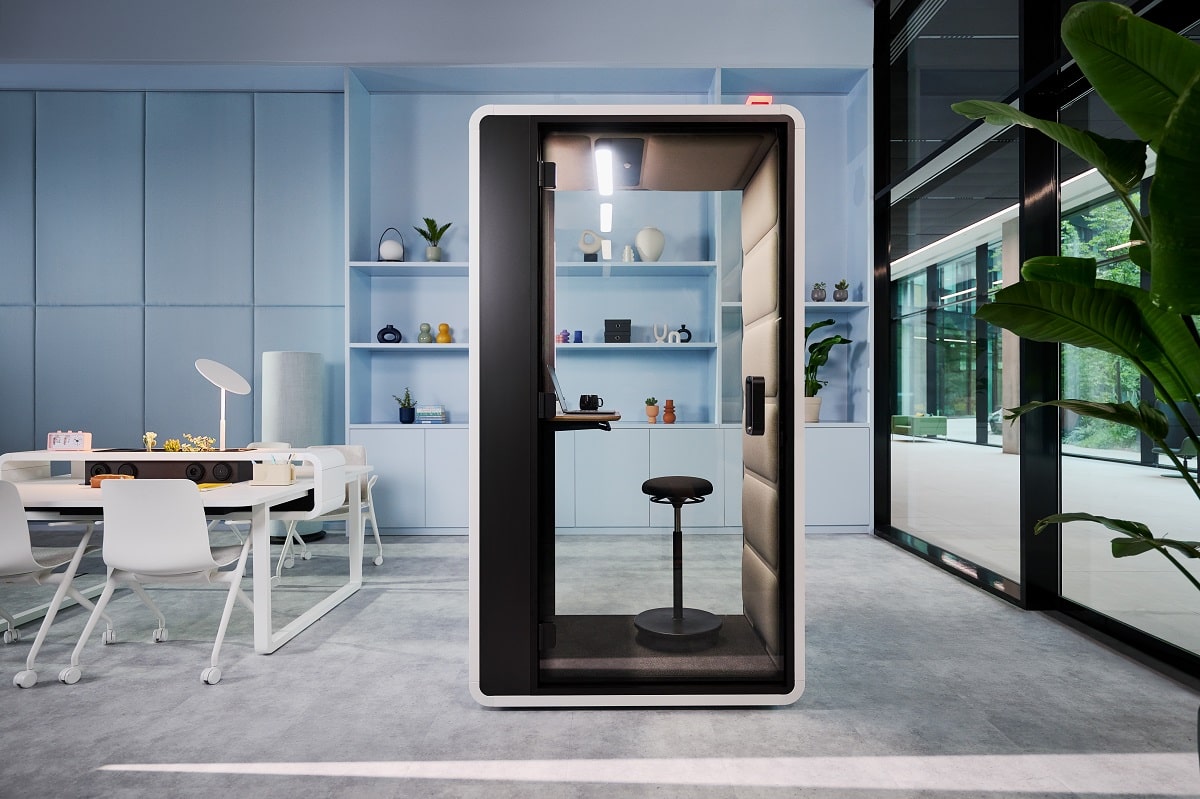
Mobile booths like hushFree act as durable, reusable assets in a shifting office. They turn the workplace into a living, adaptable environment, sliding in wherever focus or collaboration is needed.
As fixed assigned desks become inefficient, the case for flexible, reservable workspaces is strengthened.
Final thought: infrastructure for people.
If the office is going to earn its place in 2026, it must support people in ways that a distant keyboard or a calendar invite cannot. It must offer predictable privacy, dignified control over stimulus, ergonomic comfort, and the ability to repurpose space quickly.
tl;dr
Hybrid stabilizes, making flexibility mandatory
Well-being becomes a core business concern
Offices will be organized as ecosystems with distinct, interoperable zones
AI increases the premium on human-focused spaces
Sustainability and mobility as inseparable imperatives
Author: the Hushoffice team
Hushoffice Frequently Asked Questions
Why are flexible, reservable spaces becoming essential in 2026 offices? Hybrid schedules are stabilizing, but on-site attendance is rising — meaning offices must support fluctuating daily headcounts without reverting to permanent assigned desks. Reservable spaces give employees predictable access to privacy, focus, and meeting areas even in a dynamic environment. Pods help solve this demand by providing bookable, enclosed spaces that guarantee availability for important tasks without requiring large meeting rooms or dedicated offices.
How do acoustic pods support employee well-being in a busier office landscape? Stress levels remain elevated, and many employees cite noise, overstimulation, and lack of privacy as key contributors. As companies prioritize mental health, quiet micro-environments are becoming central to workplace design. Acoustic pods create low-stimulus, controlled spaces where employees can decompress, think clearly, or handle sensitive conversations — offering psychological recovery without leaving the building.
Why are mobile and modular elements like pods important for sustainability in 2026? Organizations are under pressure to reduce waste, avoid unnecessary build-outs, and extend the life of existing spaces. Mobile, modular elements reduce the need for construction and can be reconfigured as needs change, making sustainability a built-in feature rather than a costly project. Pods support this shift by acting as reusable architecture — movable, long-lasting, and easily repurposed across zones, helping companies evolve without generating renovation waste.
The most important office design trends for 2024 There may be no better time than a new year to rethink the make of the space people spend nearly 20% of their life in focused effort: the office. To…
Office trends 2024 contd. Downsizes, amenities, flex space. We approach the end of the Q1. Let’s revisit office industry patterns for the year ahead. And with a higher-level look at implications in real estate in particular. Eminent are…
Workplaces that scale: future-proofed office design… Innovation moves fast and decision-making is daily for teams at the very beginning. The physical environment needs to be responsive on the daily yet agile long-term.