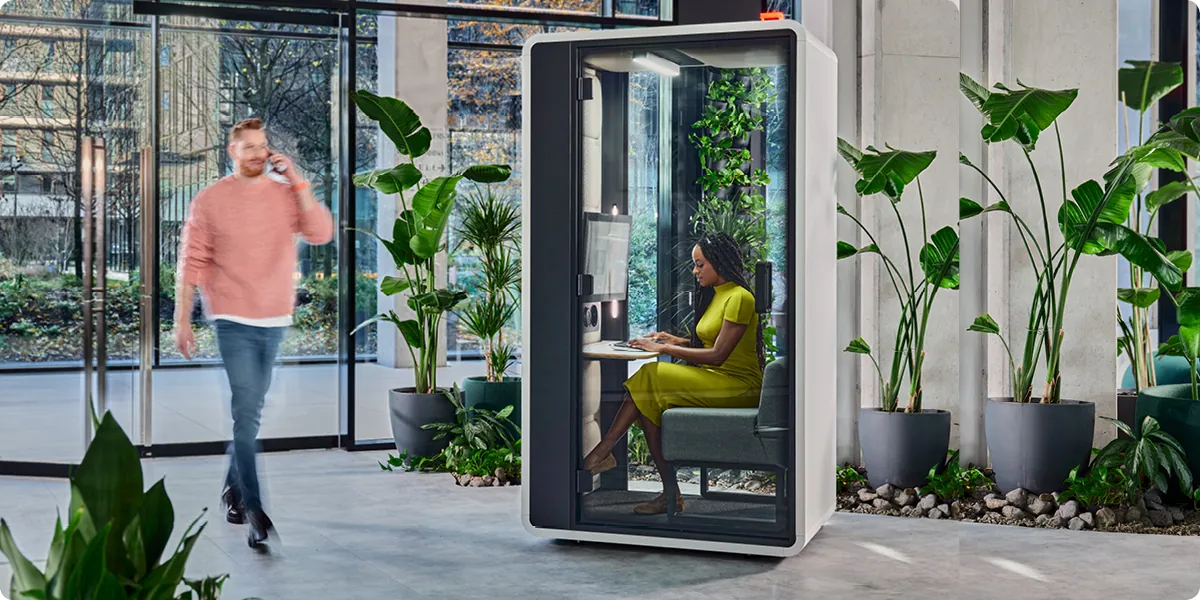
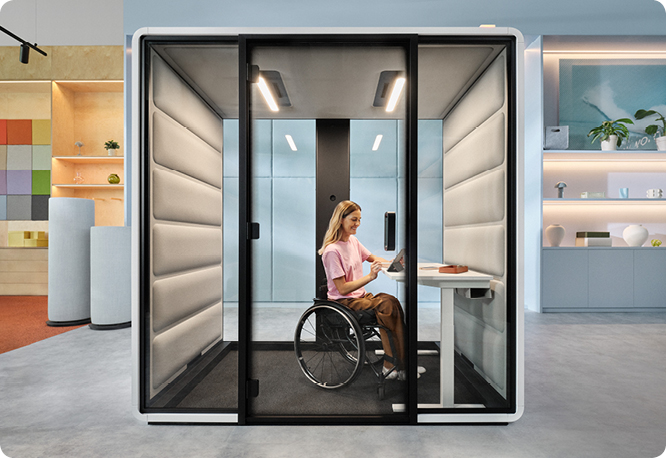
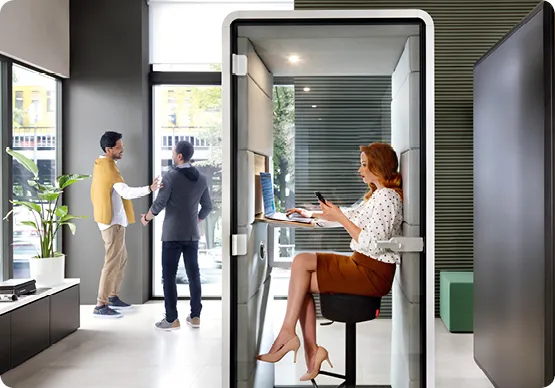
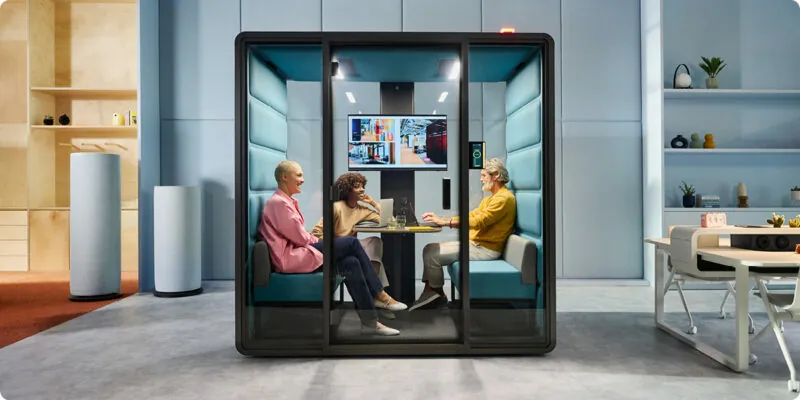
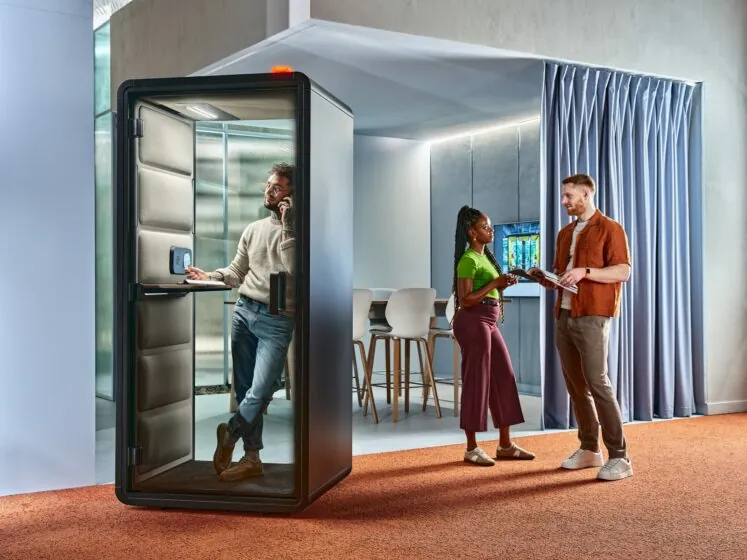
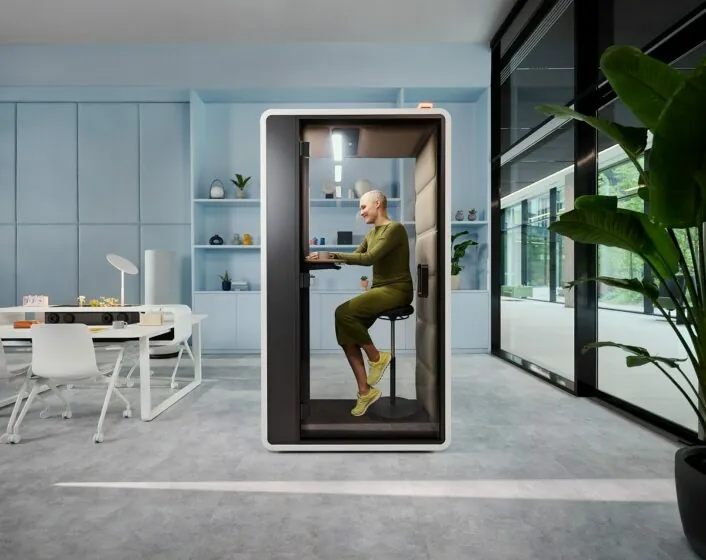
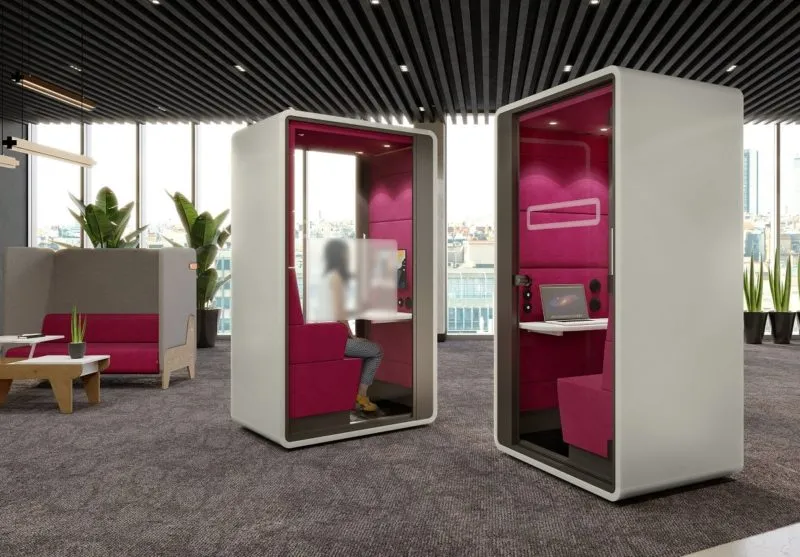
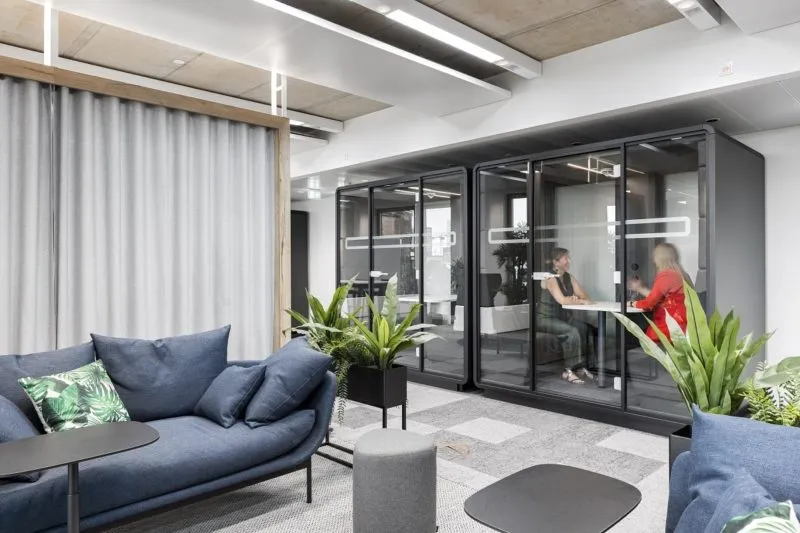
People have started working on site more often, routine tasks are increasingly covered by AI, and expectations around comfort and agency at work are rising. In this context, movable acoustic solutions and compact private spaces such as hushFree pods offer people the environmental control they require for peak performance.
tl;dr
Working hybrid becomes stable, flexibility essential
Staff well-being will be a core concern for business
Offices are evolving into ecosystems with interoperable, distinct areas
AI raises the value of spaces designed for people
Mobility and sustainability are becoming imperatives that are inseparable
Trend #1: Working hybrid becomes stable, flexibility essential.
Across the past year, many organisations have shifted away from improvised hybrid arrangements toward defined rhythms. Hybrid employees are now spending a larger share of the week on site compared with the immediate post-pandemic period.
Reservable spaces are essential in a hot-desking, hybrid world.
In environments where desks are shared and availability fluctuates daily, bookable spaces matter. Pods offer employees a dependable, enclosed place to concentrate without claiming a fixed workstation. They introduce continuity into workplaces where seating arrangements constantly change.
Booths and pods help absorb the unpredictability bult into hybrid work schedules.
One of hybrid work’s less visible stressors is uncertainty. This is not only over who will come in, but about the feel of the office on any given day. Noise levels, movement, and social density can shift dramatically. Employees need more than privacy; they need insulation from that variability.
For neurodivergent staff, work pods such as hushFree.S.Hybrid provide a safe, stable anchor.
Regardless of how crowded or stimulating the office becomes, a pod delivers the same acoustic conditions, lighting balance, enclosure, and sensory calm each time.
“The stability of sensory conditions is enormously important for people who function best with predictable environments, in particular neurodivergent employees. Predictability reduces anxiety and supports psychological safety. When surroundings constantly change — new sounds, visual motion, shifts in social energy — a person’s brain expends extra effort simply regulating itself. A pod functions as a sensory anchor point. Inside, there are no surprises. That absence of constant monitoring frees mental capacity for thinking, creativity, and active participation,” says Hushoffice Senior Marketing Specialist, Marcin Ścigała.
HushFree.S.hybrid acts like a small anchor within spatial volatility. It provides stable sensory conditions that don’t change from day to day.
Trend #2: Staff well-being will be a core concern for business in 2026.
Organisations are treating well-being as a strategic concern for 2026. Many offices are introducing dedicated areas for calm, recovery, and low stimulation. As awareness grows around the connection between sensory comfort and mental health, acoustics, lighting, and ergonomics are being deliberately tuned to support balance.
On-site recovery spaces such as hushFree booths are more important than ever.
Booths and pods offer environments that feel safe and low in stimulation. They allow employees to regulate their nervous systems during the workday. Brief, protected pauses help interrupt stress cycles highlighted in research on well-being.
Balanced acoustics, visual simplicity, and spatial consistency help the nervous system shift from heightened alertness toward regulation. These physiological resets restore a sense of control, supporting steadier concentration and a more pleasant working rhythm.
“Before we are knowledge workers, we are sensory beings. Long before rational thought engages, the nervous system evaluates sound, light, motion and temperature to assess safety or danger. Whenever those signals become unpredictable or overwhelming, the body enters a defensive state that quietly drains patience and attention. Workplace performance is therefore inseparably linked to the sensory conditions surrounding us. Pods are effective because they reduce that load. They soften inputs, quiet background stressors, and create an environment in which the mind focuses while the body does not need to remain on guard,” says Hushoffice Senior Marketing Specialist, Marcin Ścigała.
Trend #3: Offices are evolving into ecosystems with interoperable, distinct areas.
Booths and pods as modular elements within this system.
Booths allow people to shift scale effortlessly — from group interaction to individual focus, from energetic collaboration to low in stimuli work. They make transitions smoother and reduce friction between different modes of working.
Pods increase autonomy, reduce stress and support cognition.
For the brain, choice means safety. When employees can select where and how they work, stress hormones decline while intrinsic motivation rises. Cognitive sharpness improves. An office populated with pods of varying sizes and sensory qualities multiplies these choices, making autonomy tangible.
“As artificial intelligence takes on more repetitive tasks, the real value in human work shifts toward areas machines just cannot replicate — creativity, empathy, social reasoning. This requires rethinking roles, workflows, and the spaces that support them. Employees need environments that enable deep concentration as well as thoughtful exchange. The work that is most important today depends on clarity rather than simple execution. That’s why booths such as hushFree matter: they offer a setting low in stimuli that allows people to collaborate with AI in a genuinely human way, without constant interruption from the office all around,” says Hushoffice Senior Marketing Specialist, Marcin Ścigała.
Human work is either cognitive or cerebral and requires unbroken attention.
Trend #5: Mobility and sustainability are becoming imperatives that are inseparable.
Current industry trend reports highlight modularity and life-cycle thinking as today’s growth areas for workplace design.
Mobile furniture underpins sustainable office strategy.
Furniture that can be relocated, reused, or adapted as organisational needs shift reduces reliance on frequent refurbishments and structural changes. This kind of adaptability cuts material waste, lowers embodied carbon, as well as extends the usable life of workplace assets, translating sustainability from aspiration into daily practice.
Every relocatable or reconfigurable piece of office furniture enables space to change without ongoing environmental cost.
Every relocatable or reconfigurable piece of office furniture enables space to change without ongoing environmental cost.
Booths move in step with the way work evolves.
Mobile acoustic booths such as hushFree unction as long-lasting, reusable infrastructure within fluid office environments. They allow workplaces to reconfigure quickly, positioning collaboration or focus precisely where it is needed, without demolition or rebuilds.
As fixed assigned desks become inefficient, the case for flexible, reservable workspaces is strengthened.
Closing thought: people-first infrastructure.
In 2026, for the office to justify its role, it must deliver what remote tools cannot. That means reliable privacy, control over physical comfort, sensory input, and the freedom to reshape space rapidly as needs change. Offices that succeed will do so by supporting people first, not by defaulting to static layouts.
tl;dr
Working hybrid becomes stable, flexibility essential
Staff well-being will be a core concern for business
Offices are evolving into ecosystems with interoperable, distinct areas
AI raises the value of spaces designed for people
Mobility and sustainability are becoming imperatives that are inseparable
Written by Hushoffice team members
Hushoffice FAQ
Why are bookable, flexible spaces becoming indispensable in 2026 workplaces?
While hybrid patterns are becoming stable, in-office attendance is increasing. Offices must therefore accommodate fluctuating daily occupancy without returning to permanently assigned desks. Bookable spaces provide employees with dependable access to privacy, meeting areas and focus zones within an environment that remains dynamic. Pods respond to this demand by offering enclosed, reservable environments that ensure availability for key tasks without relying on private offices or larger conference rooms.
How can acoustic pods contribute to well-being in busier offices?
Stress remains widespread, with many employees identifying noise, sensory overload, and the lack of privacy as major challenges. As organisations elevate mental health within workplace strategy, small-scale quiet environments have become essential. Acoustic pods deliver controlled, low-stimulation settings where people can reset, concentrate, or manage sensitive discussions — offering meaningful psychological relief while remaining in the office.
Why do mobile, modular solutions matter for sustainability going forward?
Companies face growing pressure to avoid unnecessary construction, limit waste and maximise the lifespan of existing interiors. Modular, movable elements minimise the need for disruptive build-outs and are adaptable to evolving requirements. Pods support this approach by acting as reusable architectural components — durable, relocatable, and adaptable across multiple zones — enabling offices to change over time without unnecessary waste on renovation.
The paramount trends in office design for 2024 There might not be a better moment than the start of a new year to reconsider the design of the place where individuals dedicate over 20% of their lives intently:…
Top workspace design trends for 2025 As we approach the new year, several trends influence office environments. Inclusivity. Adaptability. Technology.
Why human-centric office design? In human-centric design, employees lie at the core of all decisions concerning office aesthetics, acoustics, and overall atmosphere. So, what is the idea behind this approach?
How will the metaverse influence office design? The metaverse is expected to produce up to $5 trillion in revenue by 2030. Naturally, businesses that don’t participate in it, face a competitive handicap. So, the question arises: how…
Improving office ergonomics with Activity-Based… By creating a workspace following ergonomic principles, you bring comfort to your employees’ working environment. An Activity-Based Workplace approach supports this idea by providing an in-depth understanding of employees’ day-to-day…